

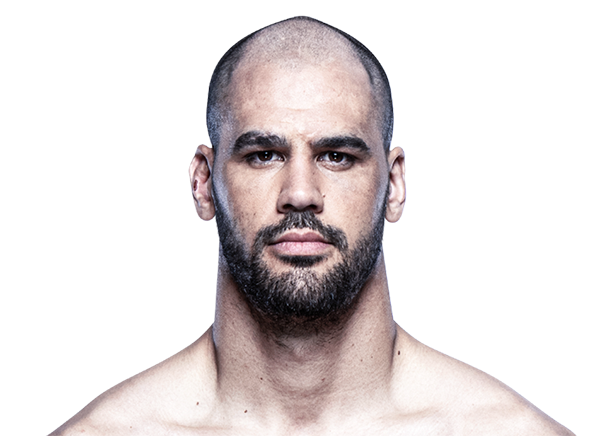
The matchup in numbers
Yousri Belgaroui lands 6.44 significant strikes a minute and absorbs 2.28. That is a differential of +4.16, and it describes a striker who wins the exchange almost every minute he is in the pocket. Caio Borralho lands 3.47 and absorbs 2.61, a differential of +0.86. He wins exchanges, but narrowly.
The efficiency numbers tilt the same way. Belgaroui connects at 63 percent and defends 63 percent. Borralho is at 56 and 60. Belgaroui throws almost twice the volume with better accuracy and slightly better defense. Output like that usually gets punished in the form of a reputation, and here it has been: three UFC wins, all by KO/TKO.
The counterweight is the rating. Borralho sits at 1602 and ninth in the division. Belgaroui is at 1549 and 21st. The rating prefers the man with the longer résumé, and the win probability of 60 percent for Belgaroui leans on the striking rates instead.
Where Caio Borralho wins it
Borralho wins this by making it a fight on his terms and not a kickboxing match at long range. Belgaroui stands five inches taller, 78 to 73, and has a four-inch reach edge, 79 to 75. Borralho cannot trade at the end of that jab for fifteen minutes and expect the differential to hold.
The route is the level change. Borralho shoots 1.25 takedowns per 15 minutes at 50 percent accuracy, and Belgaroui defends only 66 percent. That is the softest number on Belgaroui's sheet. It is also a modest margin: Borralho's own takedown defense is 76 percent, ten points better.
The southpaw stance helps too. Borralho is an experienced southpaw facing an orthodox fighter, and his 0.4 submission attempts per 15 minutes shows the grappling threat is real. He submitted Michal Oleksiejczuk in round two in April 2023 and stopped Paul Craig in round two in May 2024. His last five is 4-1, with a win over Reinier de Ridder in March 2026. That is a résumé built across more rounds than Belgaroui has fought.
Where Yousri Belgaroui wins it
Belgaroui wins it with output. At 6.44 strikes a minute he outworks nearly any opponent who stays at range, and his 2.28 absorbed is lower than Borralho's 2.61. Volume plus defense is how a differential of +4.16 gets built.
He also finishes. His last three are a first-round KO/TKO of Djorden Santos at 4:25 in September 2026, a third-round stoppage of Mansur Abdul-Malik at 3:39 in March 2026, and a third-round stoppage of Azamat Bekoev at 0:55 in October 2025. Two of those came late, which suggests the pace holds up. In a three-rounder, that matters.
The skeptic's note is sample size. Three UFC fights is not a career-length differential, and Borralho has lasted five rounds with Nassourdine Imavov and Jared Cannonier. Absorbing 2.61 a minute across that kind of distance says something about chin and durability that Belgaroui has not yet had to show.
What decides it
Two things. First, whether Belgaroui can keep the fight at range. If he does, the reach and the volume point one way. If Borralho closes the distance and drags it to the fence, the 4.16 differential shrinks quickly, because Belgaroui's defense is 63 percent but his takedown defense is 66.
Second, whether the pace survives. Belgaroui has not needed fifteen minutes since joining the UFC. Borralho's last three decisions went the distance each time, twice over five rounds. Over three rounds, Borralho's patience is a workable plan. It is only a plan if the takedowns arrive early.
The Cage Nightly read
This is a measuring-stick fight for Belgaroui and a genuine test for Borralho. The numbers back Belgaroui's reputation as a volume striker: +4.16 is not a hype number. They question the idea that his three finishes prove he has solved a ninth-ranked middleweight. The 60 percent win probability looks generous given that Borralho's rating is 53 points higher at 1602 to 1549, and given that Belgaroui's grappling defense is the weak spot in an otherwise strong profile. The striking differential argues for Belgaroui. Everything else argues for caution.